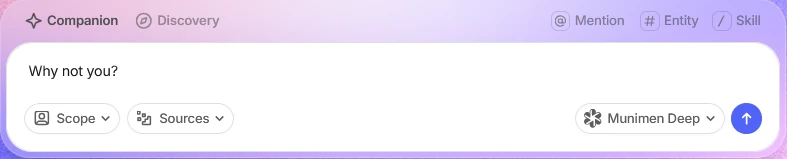
The why behind every decision, one question away
In a product and engineering team, the what lives in the code and the tickets, the why in a Slack thread nobody will find again. Munimen connects GitHub, Jira, Linear, Confluence, Notion and Slack, and makes that context available to the team and to its coding assistants.
Where it hurts today
The situations that keep coming back, and what they cost your teams.
Decisions scattered around
The ticket says what was done. The reason sits in a long Slack thread, buried for months under dozens of other discussions.
Specs out of date
The Confluence page dates from launch. Several tickets have contradicted it since, and nobody updated it.
Senior engineers interrupted
How this service runs, why this architecture, who owns this module: the same questions keep landing on the same people.
Assistants without context
Cursor or Claude write decent code in general, but know nothing of your conventions, your past choices or what was already ruled out.
What Munimen changes
What changes once Munimen connects your tools and your knowledge.
A decision’s trail, rebuilt
Ask why an option was dropped: Munimen searches Slack, Jira, Linear and Confluence at once, and answers citing each source.
What changed since the spec
Every fact is dated: when a ticket or a discussion revisits a spec, Munimen answers with the most recent decision, with its sources.
Seniors interrupted less
Companion answers first, with its sources. When a question really needs an expert, Munimen points to who knows more.
Your conventions in Cursor
Through MCP, your coding assistants can query Munimen for architecture decisions, team conventions and the current specs.
Munimen is for you if
If several of these sound familiar, let’s talk.
- Your technical decisions happen in Slack and get lost afterwards
- Your Confluence or Notion specs no longer keep up with the product
- Your senior engineers keep answering the same questions
- Your team codes with Cursor, Claude or another MCP client
Frequently asked questions
Short answers to the questions we’re asked most often.