AI hallucination examples: five cases and what caused them
Two court rulings, three reconstructed workplace cases, the cause behind each, and a way to check an answer.
 Kilian9-minute read
AI hallucination examples share one pattern: a confident, plausible answer that no source supports. A language model writes the most likely continuation of the text, whether it is true or not. Ask a general assistant about ACME's contract without giving it the contract V3, and it may answer six months' notice instead of three. At work, the cause is usually the context the model was given.
The same model, asked the same question, gets it right once it reads the right document. Each case below names where the error came from and which context would have prevented it.
What an AI hallucination is
A model predicts text. When the information is missing, it fills the gap with something that sounds right.
A large language model, or LLM, the engine behind ChatGPT or Claude, is trained to predict the next word. It does not look facts up before it writes. It produces the most probable wording given the question and whatever text sits in its context.
So an AI hallucination looks like a good answer. It has the right tone and format, sometimes a case number or a file name. What it lacks is a link to a source, and nothing in the sentence tells the true apart from the plausible.
Inside a company, two kinds of error show up. In the first, the model has no documents and answers from general knowledge. In the second, it has documents but leans on an outdated version, or blends two entities into one. The second kind misleads more, because the answer rests on a real file.
Either way, the fix is better context, and the check is the cited source.
Five AI hallucination examples, from court to the office
Two cases decided by courts, then three reconstructed cases set in the ACME world, each with its cause.
The last three are reconstructed examples. ACME, an industrial customer, and Marc, a sales rep at ACME who has since left, are fictional characters used across this blog.
Mata v. Avianca, June 2023: court cases that never existed
In March 2023, a New York law firm filed a brief against the airline Avianca. It cited decisions produced by ChatGPT, including "Varghese v. China Southern Airlines", with quotes and citations. None of them existed. When one of the lawyers later asked ChatGPT whether Varghese was real, it said the case did exist.
On 22 June 2023, Judge P. Kevin Castel of the Southern District of New York imposed a $5,000 penalty on the two lawyers and their firm (Mata v. Avianca, 22-cv-1461, opinion and order on sanctions, June 2023, accessed 1 November 2026).
Cause: no case law database in the model's context, and a check handed back to the model itself.
Air Canada, February 2024: a refund rule the chatbot made up
In November 2022, Jake Moffatt booked a flight after his grandmother died. The chatbot on Air Canada's website told him he could apply for the bereavement fare after travel. The actual policy, on another page of the same site, did not allow that.
On 14 February 2024, British Columbia's Civil Resolution Tribunal ordered Air Canada to pay CA$812.02, including CA$650.88 in damages (Moffatt v. Air Canada, 2024 BCCRT 149, February 2024, accessed 1 November 2026). The tribunal held that the company answers for all the information on its website, chatbot included. How far that reasoning travels outside Canada is a question for your lawyer.
Cause: two conflicting sources on one website, and an answer that cited neither.
Three months' notice read as six (reconstructed example)
An account manager asks a general assistant for the termination notice in the ACME contract. The assistant has no documents and answers "six months", with no source. The contract V3, the version in force, says three months' notice. When the customer sends its termination three months before the end date, the team disputes it and is wrong.
Cause: missing context.
Marc named as the decision maker (reconstructed example)
"Who signs off on the renewal on the customer side?" The assistant answers "Marc", pulled from last year's meeting notes. Marc has since left. The proposal goes to someone who is no longer there.
Cause: an outdated source, with no date attached and no record of the departure.
The acronym nobody defined (reconstructed example)
A new support agent asks what "PSR" means in a ticket. The assistant expands it as "Product Support Request". Internally, PSR is the name of a premium service plan, and the agent quotes the wrong terms to a customer.
Cause: in-house vocabulary that the model has never seen, a daily risk for support teams.
In all five cases, a visible source would have prevented the error or exposed it early.
Five causes, from missing context to an undersized model
The order follows how easy each cause is to fix: four are fixed with context, the last one with the model.
No public study ranks these causes by how often they occur inside companies. The list runs from the easiest to fix to the most costly.
- Missing context: the model has no document and answers from memory, as with ACME's notice period.
- Outdated source: the contract V2 and the contract V3 are both reachable, and the search returns the V2.
- Confused entities: two Marcs, three ACMEs, and passages attached to the wrong customer.
- Ambiguous question: "the notice period in the contract" without saying which contract, so the model picks one.
- Undersized model: a small model can lose track of a long context and blend two passages.
The first four causes go away without changing the model. In the reconstructed notice example, the same model answers three months once the contract V3 is in its context. The reliability of an assistant at work depends first on what it is given to read.
For the fifth cause, test a few models on your own questions before you pick one. Munimen lets the company choose its model: Mistral is included, and OpenAI, Anthropic, Google, Azure OpenAI, Amazon Bedrock or Ollama can be connected.
What retrieval fixes and what it leaves
Fetching the right passages before answering solves missing context. Versions and look-alike names still need work.
RAG, short for retrieval-augmented generation, adds the passages from your documents closest to the question before the model writes. The model then answers from that text instead of its general knowledge. Any company knowledge base you can query in plain language rests on this idea.
Retrieval fixes the first cause. ACME's notice period no longer comes out of nowhere, it comes from a contract. The made-up acronym disappears once the internal glossary sits in the indexed documents.
Retrieval does not make hallucinations disappear, though. In May 2024, a Stanford team tested legal research tools built on RAG, from LexisNexis and Thomson Reuters. Each one hallucinated in 17% to 33% of the queries tested (Magesh et al., Stanford, May 2024, accessed 1 November 2026).
Causes two to four survive retrieval. The search can return the V2 because it matches the question as well as the V3 does. It can mix passages about two different ACMEs. It cannot guess which contract the person had in mind.
Three mechanisms sit on top of retrieval:
- entity resolution, so that every spelling of a customer points to one entity;
- memory of dated facts, drawn from the team's conversations, to place a fact in time;
- sourced answers, so the reader sees which document each claim comes from.
Munimen does not pick between two versions of a contract on its own. Its answer cites the document the notice period came from, so the reader sees whether it is the V2 or the V3. Keeping documents current belongs to the knowledge management system around it.
How to check an AI answer before you reuse it
A sourced answer is checked by going back to the cited passage before it reaches a customer.
No tool guarantees zero errors, so checking stays the last safety net. It takes little time when the answer cites its sources. These five steps work with any assistant.
- Open the cited source and find the exact passage. If there is no source, treat the answer as a guess.
- Compare the value in the answer with the value in the passage: three months on both sides.
- Check the document version: the contract V3 in force, not the V2.
- Check the entity: the right customer, the right subsidiary, the right Marc.
- Rephrase when in doubt: "Quote the notice clause from ACME's contract V3."
The Avianca case shows where step five stops working. Asking the model whether it is right checks nothing, and only the document settles it.
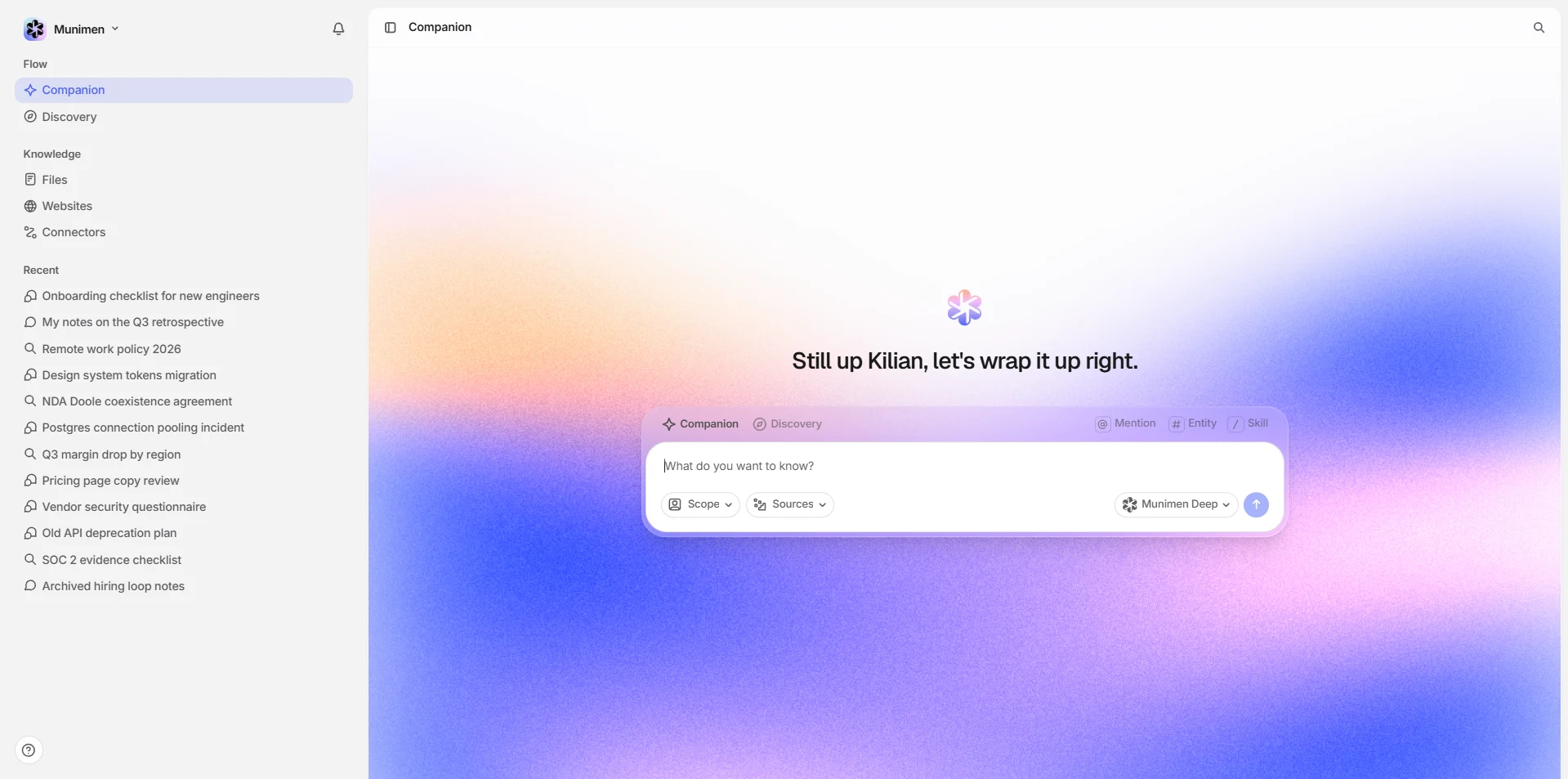
In Munimen, Companion answers with its sources, which open from the answer itself. Steps one and three happen without leaving the conversation.
Without Munimen / With Munimen
The same model and the same question about ACME's notice period, with and without the company's context.
The model stays the same from one column to the other. Only the context changes: contracts connected from Google Drive, resolved entities, the team's memory. By default, Mistral AI generates the answers, and indexing runs on Munimen's own servers in Paris, France.
Munimen does not replace a lawyer reading a sensitive clause. For a general assistant, the detailed comparison is on the page ChatGPT Enterprise compared with Munimen.
| Without Munimen | With Munimen |
|---|---|
| The assistant answers "six months" with no document | The answer draws on the connected ACME contracts and cites the passage |
| The contract V2 and the contract V3 come back with nothing to tell them apart | The cited source shows whether the notice period comes from the V2 or the V3 |
| Three spellings of ACME return three unrelated results | Every spelling of ACME points to one customer, with its contracts and contacts |
| Marc is still named as the decision maker after he left | A departure mentioned in a conversation becomes a dated fact in memory |
| Checking means finding the file by hand | Every answer cites its sources, opened from the answer |
| Claude or ChatGPT answer without the company's context | Claude or ChatGPT query the same knowledge base through MCP |
Frequently asked questions
What is an AI hallucination?
An AI hallucination is a plausible, confident answer that no source supports. The model writes the most likely text without checking that it is true. At work, it usually comes from missing, outdated or confused context, like six months' notice quoted when the contract V3 says three. Entity resolution in Munimen handles the confused part.
Why does ChatGPT make things up?
ChatGPT writes the most probable text from its training and from what you give it. Without your documents, it knows neither your contracts nor your customers, and it fills the gap with plausible wording. Connecting your sources lowers that risk. The ChatGPT Enterprise comparison covers what each tool can read.
How do you reduce AI hallucinations at work?
Give the model the right documents, kept current, and require sourced answers. In practice: connect the tools where knowledge lives, resolve entities so each customer has one name, date the facts, then check the cited passage. Unapproved tools make this harder, as the article on shadow AI explains.
Can RAG eliminate hallucinations?
No. Even tools built on retrieval produce them: between 17% and 33% of the queries tested in the Stanford study published in May 2024. The realistic goal is to make every error visible. An answer that cites its source can be checked in seconds, as the sourced answers in Companion show.
What is the difference between a hallucination and an entity mix-up?
A hallucination produces information that no source contains. An entity mix-up starts from a real source about the wrong Marc or the wrong ACME. Both give a wrong, confident answer, but the fixes differ. A knowledge management system that tracks entities reduces the second kind.
Written by KilianFounder of MunimenPublished on November 6, 2026